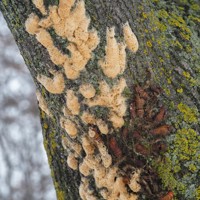
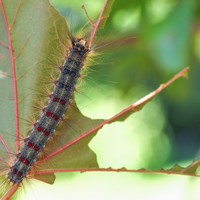
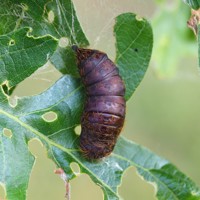
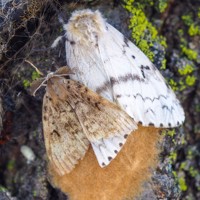
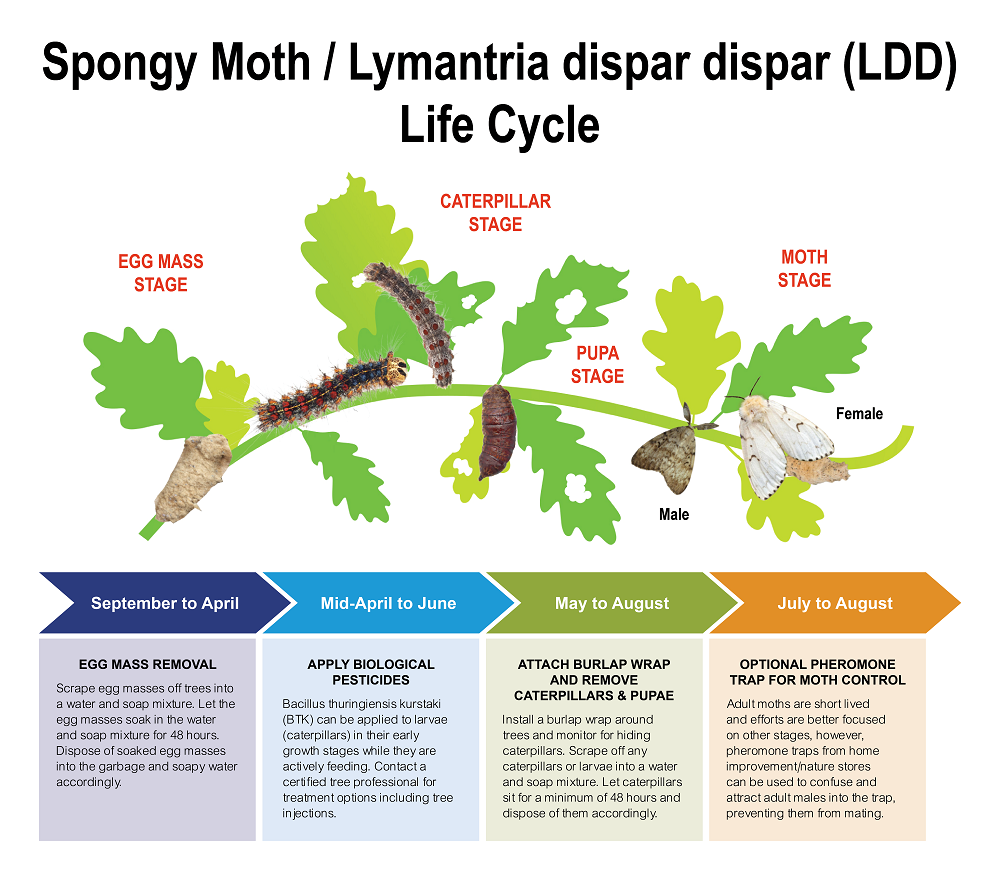
Same insect; new name: The Entomological Society of Canada (ESC) has adopted the new common name of 'Spongy moth' for Lymantria dispar dispar (LDD) moth. The Township, among many other government, agencies is adopting this new name.
The Spongy moth is a non–native insect pest that has become endemic to much of Southern and Central Ontario, with outbreaks occurring every seven to ten years. The invasive Spongy moth in Ontario is beyond the stage where it can be eradicated and as a result is expected to continue to have periodic population increases with varying levels of defoliation. In Ontario, major outbreaks have peaked in 1985, 1991, 2002, and 2008. Additionally, there was an upsurge in Simcoe County beginning in 2019, with moderate to severe levels of defoliation in 2020 and 2021.
Spongy moth outbreaks are not uniform throughout municipalities, forests, and woodlots each year. The population level in specific areas depends on several factors, including forest composition (tree species), weather conditions and topography / landscape features. Spongy moth populations vary annually and fluctuate with local conditions.
Despite the successful use of insect predators, as well as fungal and viral controls, Spongy moth populations do occasionally reach outbreak levels and continue to expand their range. Spongy moth caterpillars defoliate host trees, mostly hardwood species such as oak, birch, poplar, willow, maple and others. During peak outbreak years, broadleaf trees may be completely defoliated, caterpillars appear everywhere, and 'frass' (caterpillar droppings) appear to rain from the trees.
As experienced in 2020 and 2021, Spongy moth outbreaks are triggered by warm winters and hot, dry spring and summer months. However, a series of natural factors can cause a Spongy moth population collapse. These include cold winter temperatures (below -20°C), heightened tree defenses (i.e., development of tougher leaves from regrowth and less nutrients), competition for food, predation, parasitism, and naturally occurring diseases—NPV (nucleopolyhedrosis virus) and an introduced fungus (entomophaga maimaiga).
NPV is one of the most important factors in the collapse of Spongy moth outbreaks in North America. NPV spreads naturally when caterpillars are abundant, regardless of weather conditions. Its presence has been detected in Simcoe County Forests and within the Township. In turn, the fungal disease is dependent on cool wet weather to facilitate the spread of fungal spores. Both naturally occurring diseases result in mass mortality of Spongy moth larvae, supporting the known cyclical nature of Spongy moth outbreaks.