Plaques and Monuments

Have you ever passed one of Springwater’s historic plaques or monuments and wondered about the people, places, and events behind it? These local landmarks help tell the story of our community, preserving memories of early settlers, significant milestones, and the heritage that continues to shape Springwater today.

Explore the stories behind these meaningful sites through the Township of Springwater Cultural and Heritage Advisory Committee’s Plaques and Monuments Article Series. Discover the history, context, and community connections behind the markers found throughout our Township.

First Meeting of Flos Township Council 

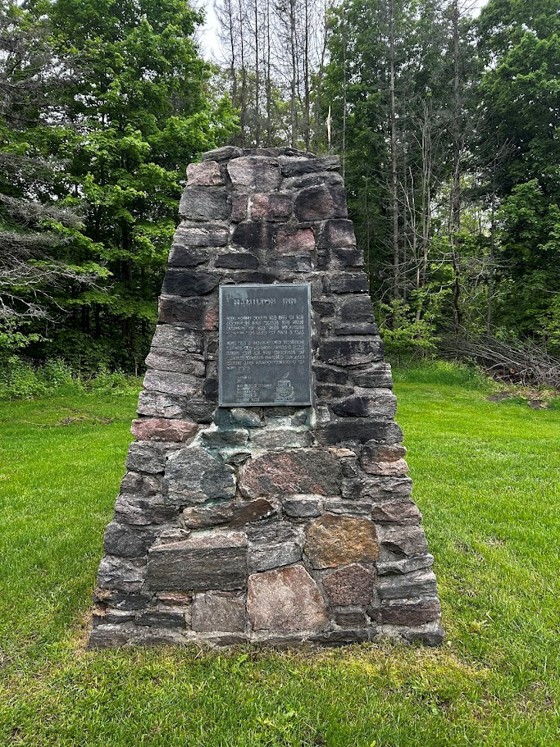
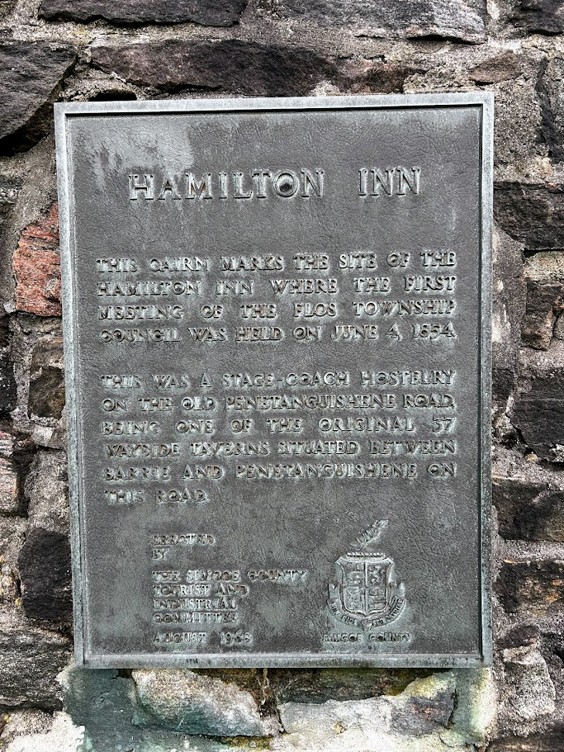
In a small field, set back from Penetanguishene Road just north of Hillsdale, lies a triangular fieldstone cairn and plaque. While small and relatively rural, it marks a place that had a significant connection to local history and even to provincial governance: It was the location of the first meeting of the Council of the Township of Flos, on June 4, 18541

Flos, for those unfamiliar, was one of the predecessors to what is now the Township of Springwater2. It was roughly the north part of Springwater, extending from Horseshoe Valley Road to the boundary with Tiny Township3. The mid-19th century was a time of increasing settlement and agricultural development in north Simcoe County. The Penetanguishene Road had been surveyed and constructed years earlier in the early to mid 1810s4, and Flos’ population grew from around 200 in 1842 to to around 2,500 in 18815. To the east, the historic Oro-African Methodist Episcopal Church was being built in the latter part of the 1840s6

Given this growth, the establishment of representative municipal government marked by this first meeting was an important milestone for the early history of the area. It was spurred on by a new provincial (then the Province of Canada) framework for local government — the Baldwin Act, 1849. This act was largely seen as creating a full new system of local municipalities — cities, towns, villages, and townships — and granting them the power to tax, spend, and create by-laws, and elect representatives from within their boundaries. Earlier legislation had existed, and Vespra to the south had representative local government as early as 18377, but Simcoe County historian Andrew Hunter called the new act “much more comprehensive8,” and in any event it more closely preceded the first true act of local governance in Flos — the 1854 Council 
meeting.  

The Council met at the Hamilton Inn just north of Hillsdale on Penetanguishene Road, which hosted a tavern and rooms for overnight travellers. It was one of several such businesses on that important route, which connected the growing town of Barrie to the military and shipping operations on Georgian Bay. Family history9,10 and local legend suggests that the Inn was built by William John Davenport, a prominent local builder who is also purported to have constructed such buildings as the Hillsdale Lock-up and the Simcoe Hotel at the 5 Points intersection in Barrie. Davenport was the grandson of a Black settler also named William John, who was freed from slavery in the southern United States and came to Canada in 1810. Fighting for Canada in the War of 1812, he was granted land in 1819 at what is today Hillsdale11, making him among the first permanent settlers of Flos12.  

The Hamilton Inn itself no longer stands, but the cairn that marks its place can be visited at 4964 Penetanguishene Road, Springwater, between Hillsdale and Orr Lake. 

- Written by the Township of Springwater Cultural & Heritage Advisory Committee 

Photograph of Simcoe County Tourist and Industrial Committee's "Hamilton Inn" Plaque, located in Springwater, Ontario, taken by Hale Mahon, May 29, 2025. 

“Our Story,” Township of Springwater Township Hall, accessed February 2, 2026,
https://www.springwater.ca/en/township-hall/our-story.aspx

"OpenGIS Simcoe Interactive Map (with Historic Geographic Township Boundary 
layer)," County of Simcoe. accessed February 2, 2026, https://opengis.simcoe.ca/public/.

4 "Penetanguishene Road, The," Ontario Heritage Trust, accessed February 2, 2026, https://maps.heritagetrust.on.ca/searchview=plaques&query=Penetanguishene+Road%2C+The&details=true&id=D67978FF-2E66-450D-8C4A-F40D96438B65.

5 Archaeological Services Inc., Stage 3 Site-Specific Archaeological Assessment: Simcoe Environmental 
Resource Recovery Centre, Gribbin Site (BdGw-49), Part of Lot 2, Concession I, Former Flos Township, 
Now Springwater Township, County of Simcoe, Ontario, (Toronto: Archaeological Services Inc., 2016), accessed February 2, 2026, https://simcoe.ca/wp-content/uploads/2024/01/5.-Archaeological-Assessment_Stage-3_Supplementary-Information-1.pdf.

6 "Oro African Methodist Episcopal Church," Township of Oro-Medonte Living Here: Culture & Heritage, 
accessed February 2, 2026, https://www.oro-medonte.ca/living-here/culture-heritage/oro-african-methodist-episcopal-church/.

Andrew F. Hunter, A History of Simcoe County. Vol. 1., (Barrie, Ontario: The County Council, 1909), page
258, accessed via Archive.org, https://archive.org/details/historyofsimcoec01huntuoft/page/258/mode/1up

8 Andrew F. Hunter, A History of Simcoe County. Vol. 1., page 258.

Blair, Fred, "The Davenport Brothers," Orillia Museum of Art & History Publications (blog), February 1, 2023, accessed February 2, 2026, https://www.orilliamuseum.org/the-davenport-brothers/page/3/?et_blog.

10 Jay Davenport, interview by Greg Barker and Hale Mahon, Beeton, Ontario, May 18, 2025.

11 Davenport, interview. 

12 Archaeological Services Inc, Stage 3 Site-Specific Archaeological Assessment: Simcoe Environmental 
Resource Recovery Centre, Gribbin Site (BdGw-49), Part of Lot 2, Concession I, Former Flos Township, 
Now Springwater Township, County of Simcoe, Ontario

Midhurst Blacksmith Shop

If you drive through the intersection of Finlay Mill Road and Doran Road in Midhurst today, you’ll hear cars braking and accelerating from the stop signs, and maybe some chatter of people leaving the pharmacy at the southwest corner.  

If you went past it for much of the time around the turn of the 20th century, you may hear the clanking of metal and conversation of locals as they did business at the village blacksmith shop, located on the north side of Doran. 

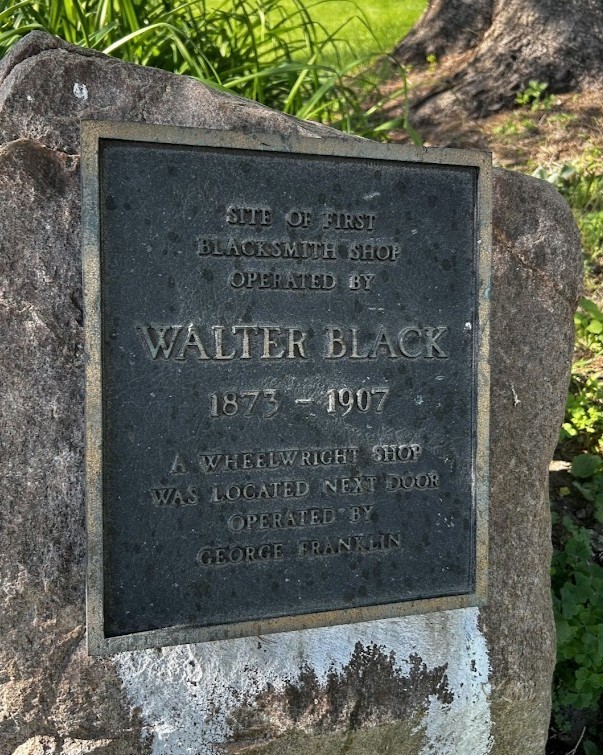
The shop was started by Walter Black, an immigrant from the Hebrides1 island of Islay in Scotland2, in 18733. It operated until Walter’s death in 19074. Walter practiced at a time when the blacksmith was solidifying into an essential village role; around the mid-1800s, blacksmiths began to consolidate a variety of distinct ironwork trades into one storefront location5.  

Black was reported to have been expert at making horseshoes, an essential technology at a time before motor vehicles. “His horseshoes lasted longer than usual6,” according to an unattributed source quoted in the History of Vespra Township. Among his clients was the fire department in nearby Barrie7, which used horses for its operations. Black also made tools for the growing local agricultural sector and “utensils that were used in every Midhurst kitchen8,” said Walter Coutts, who was present at the unveiling of the plaque in October of 1977. 

“The village smithy,” as they were sometimes called, “was always brimming with activity9,” according to the Canadian Encyclopedia’s entry on the history of blacksmithing. In many Ontario communities, it was a meeting place, a social place, and even a place to discuss politics. While we don’t have much recorded memory of Black’s shop, we do know it was often quite busy: In the History of Vespra Township, long-time Midhurst resident Hunter Russell remembers having to wait for three sets of horses to have their shoes shod. Black came out after lunch and gave Russell a sandwich consisting of homemade bread with butter and brown sugar, which Russell recalls as tasting “just wonderful!”10 

The History of Vespra Township also suggests that Black’s wife Mary was very involved in the Midhurst community. She was “an accomplished seamstress,” selling her services to support herself and her family after Black passed away11. She also assisted in over a hundred births12 .

A plaque now stands on Doran Road, opposite Finlay Mill, to commemorate the Blacks’ work in Midhurst. 

- Written by the Township of Springwater Cultural & Heritage Advisory Committee 

"Wikipedia: Islay," Wikimedia Foundation, accessed June 3, 2026, https://en.wikipedia.org/wiki/Islay

2 The Vespra Township Council, History of Vespra Township (Mika Publishing Company, 1987).

3 Photograph of "Midhurst Blacksmith Shop" Plaque, located at Finlay Mill Road and Doran Road in Midhurst, Ontario, taken by Hale Mahon, May 29, 2025.

4 "Walter Black 1851-1907," Geni, accessed June 3, 2026,  https://www.geni.com/people/Walter-Black/6000000089358860821.

5 "Blacksmithing," The Canadian Encyclopedia, accessed June 3, 2026, https://thecanadianencyclopedia.ca/en/article/blacksmithing.

6 The Vespra Township Council, History of Vespra Township.

7 The Vespra Township Council, History of Vespra Township.

8 "Barrie Examiner, 25 Oct 1977, p. 5," Springwater Public Library, accessed June 3, 2026, https://vitacollections.ca/springwaterlocalhistory/2933350/page/5

"Blacksmithing," The Canadian Encyclopedia.

10-12 The Vespra Township Council, History of Vespra Township.

Cultural and Heritage Advisory Committee

For more information on the Cultural and Heritage Advisory Committee’s initiatives and upcoming meetings, please refer to the Committee’s agendas.